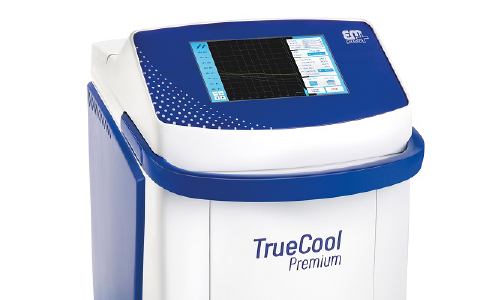
TrueCool hypothermia machine

TrueCool® therapeutic hypothermia devices (TTM)

TrueCool® targeted temperature management device is an advanced hypothermia system used to deliberately reduce the core body temperature in patients who do not regain consciousness after the return of spontaneous circulation following a cardiac arrest, ischemic stroke, or in newborns with hypoxic-ischemic encephalopathy. This non-invasive cooling blanket ICU device is essential in modern medical practice.

The TrueCool® targeted temperature management system, which functions as a hypo/hyperthermia unit, is based on a control unit for regulating temperature in combination with various pads and blankets.
The algorithm, based on information on the patient’s current core temperature, manages water temperature in pads and blankets. Cooling (or warming, depending on the requirement) pads and blankets are non-invasive and are a very effective solution to manage a patient’s temperature in a controlled manner.

A variety of patient covers is available in both disposable and reusable versions, making the cooling blanket system adaptable to various clinical needs. The device control software is intuitive, user-friendly, and gives the user the option of choosing automatic or manual modes, ensuring precise patient temperature management.

Therapeutic hypothermia

Therapeutic hypothermia, TTM, is a patient condition induced by the TrueCool cooling system using non-invasive pads and blankets. Hypothermia involves the controlled lowering of body temperature to alleviate secondary organ damage that occurs after the initial injury. Clinicians have been increasingly using therapeutic hypothermia to prevent or ameliorate various types of neurological injury and more recently for some forms of cardiac injury.

Treatment benefits​

  • reduction of perfusion rate
  • decreased ischemic injury and brain necrosis
  • decreased reperfusion injury
  • extending the time window to perform endovascular procedures
  • avoiding long-term neurologic dysfunction, permanent disabilities or even death

Indications

  • post cardiac arrest patients
  • patients with brain damage
  • patients after ischemic stroke
  • newborns with hypoxic-ischemic encephalopathy
  • febrile patients
  • accidental hypothermic patients
  • during endovascular procedures
  • trauma patients

Why Hospitals Choose TrueCool

No vascular access, and no trade-off in control. TrueCool cools and warms through the skin, avoiding the infection, bleeding and thrombosis risk that comes with a cooling catheter. It does this without giving up precision, because it regulates continuously from the patient’s own core temperature rather than from a fixed water setting. Published evidence found no significant difference in neurological outcome or survival between intravascular cooling and feedback-controlled surface cooling.

The whole therapy, not just the cooling phase. Guidance describes active temperature control for at least 72 hours after cardiac arrest — far longer than induction. TrueCool runs the full arc: cooling, maintenance, scheduled controlled rewarming and continued fever prevention, with complete protocols stored on the unit so the settings do not have to be rebuilt at every handover.

A consumable model the hospital controls. Covers are available in disposable and reusable versions. Over a five-year horizon this is usually the largest single difference between systems, and it stays a local decision rather than one fixed by the manufacturer.

Access to the patient throughout. Covers are applied to the body regions the therapy requires, so wounds, drains, surgical fields and access sites stay reachable. A patient who does not fit a standard full-body garment can still be treated.

Built by the people who answer the phone. EM-MED is a family-owned manufacturer with more than 30 years on the medical market, exporting to over 40 countries through national distributors. Approximately 2,500 EM-MED devices are in use worldwide. Service and clinical support come from the company that designed the device, not through a chain of intermediaries.

Available models

TrueCool® Premium

The TrueCool® Premium is the top-of-the-line model which features all options and functions currently available. As a TTM medical device, it includes an easy-to-use 10” touch screen, multiple cooling and warming programs, a trend screen with database and data export possibilities, making it the most accurate and versatile therapeutic hypothermia device.

  • 3 temperature probe sockets for core, skin and tympanic temperature probes
  • 10” touch screen with trend screen display
  • accuracy of patient temperature measurement 0.05°C
  • adjustment increments of temperature 0.05°C
  • database with export possibility

TrueCool® Lite

The TrueCool® Lite is a high-level portable medical cooling device meeting all the basic requirements for targeted temperature management. It features a 7” touch screen, multiple cooling, and warming programs.

  • 1 temperature probe socket – core temperature
  • 7” touch screen
  • accuracy of patient temperature measurement 0.1°C
  • temperature adjustment increments of 0.1°C

Technical Parameters

  • temperature range: water 4°C to 42°C; patient 30°C to 40°C
  • UV-C antibacterial water decontamination
  • ambient temperature (operating): 15°C to 25°C
  • storage: 10°C to 40°C
  • relative humidity: 30% to 85% (operating and storage)
  • operation: units are designed for continuous operation
  • safety: electronic and mechanical sensors prevent overheating/overcooling
  • alarms: optical and acoustic
  • power supply: 220–240 VAC, 50 Hz, 6.5 A
  • device on 4 castors (2 front castors lockable)
  • external dimensions: height 107 cm, width 50 cm, depth 55 cm (with hook open 70 cm)
  • weight (device): 66 kg
  • water capacity: 10 l
  • 1 USB socket
  • 3 inlet and 3 outlet couplings for hoses connection (quick disconnect couplings)

Hospital units with cooling systems, such as TrueCool® Premium and Lite, provide optimal patient temperature management in a variety of medical scenarios.

Downloads

Research and Clinical Guidelines

Targeted temperature management is one of the more thoroughly studied interventions in post-resuscitation care. The references below set out the evidence and the guidance that shape how controlled cooling and rewarming are used today. They describe the therapy rather than any individual device, and are provided as background for clinicians and procurement teams.

Guidelines

  • Sandroni C, Nolan JP, Andersen LW, et al. ERC-ESICM guidelines on temperature control after cardiac arrest in adults. Intensive Care Medicine. 2022;48(3):261–269. doi:10.1007/s00134-022-06620-5 — continuous core temperature monitoring and active prevention of fever above 37.7 °C for at least 72 hours in comatose patients after cardiac arrest.
  • Zanelli SA, Wusthoff CJ, Lucke AM, Kaufman DA. Therapeutic Hypothermia for Neonatal Hypoxic-Ischemic Encephalopathy: Clinical Report. Pediatrics. 2026;157(2):e2025073627. doi:10.1542/peds.2025-073627 — American Academy of Pediatrics guidance on cooling in neonatal HIE.

Clinical evidence

  • Dankiewicz J, Cronberg T, Lilja G, et al. Hypothermia versus Normothermia after Out-of-Hospital Cardiac Arrest. New England Journal of Medicine. 2021;384(24):2283–2294. doi:10.1056/NEJMoa2100591 — the TTM2 trial, which moved practice from a mandatory 33 °C target towards actively controlled temperature with fever avoidance.
  • Ramadanov N, Arrich J, Klein R, Herkner H, Behringer W. Intravascular Versus Surface Cooling in Patients Resuscitated From Cardiac Arrest: A Systematic Review and Network Meta-Analysis With Focus on Temperature Feedback. Critical Care Medicine. 2022;50(6):999–1009. doi:10.1097/CCM.0000000000005463 — no significant difference between intravascular cooling and feedback-controlled surface cooling; surface cooling without feedback performed worse.
  • CalabrĂł L, Bougouin W, Cariou A, et al. Effect of different methods of cooling for targeted temperature management on outcome after cardiac arrest: a systematic review and meta-analysis. Critical Care. 2019;23:285. doi:10.1186/s13054-019-2567-6
  • Awad A, Jonsson M, Holgersson J, et al. Intravascular vs. surface cooling in out-of-hospital cardiac arrest patients receiving hypothermia after hospital arrival: a post hoc analysis of the TTM2 trial. Intensive Care Medicine. 2025;51(4):721–730. doi:10.1007/s00134-025-07883-4

Frequently Asked Questions

What is TrueCool used for?

TrueCool is a non-invasive system for targeted temperature management (TTM) and therapeutic hypothermia. It cools a patient to a set target temperature, holds that temperature, and then rewarms in a controlled way. Published indications include post cardiac arrest care, ischaemic stroke, hypoxic-ischaemic encephalopathy in newborns, and temperature control in febrile patients.

Why does controlled cooling matter after cardiac arrest?

When blood flow stops, the brain enters an ischaemic damage cascade that continues after circulation is restored — reperfusion injury, inflammation and oedema unfold over hours and days. Controlled temperature management is the intervention used to limit that cascade. European guidance recommends continuous core temperature monitoring and active prevention of fever above 37.7 °C for at least 72 hours in comatose patients after cardiac arrest (Sandroni et al., Intensive Care Medicine, 2022).

Is TrueCool invasive? Does it require vascular access?

No. TrueCool is a surface system — heat is transferred through the skin using pads and blankets supplied with temperature-controlled water. There is no catheter and no vascular access, so the complications associated with intravascular cooling — infection, bleeding, vascular injury, thrombosis — do not apply.

How does the system know how much to cool?

It works in a closed loop. The control unit reads the patient’s core temperature continuously and adjusts the temperature of the water circulating in the covers to hold the target the clinician has set. This is what matters clinically: published evidence found no significant difference in neurological outcome or survival between intravascular cooling and surface cooling with temperature feedback, while surface cooling without feedback performed worse (Ramadanov et al., Critical Care Medicine, 2022).

Can TrueCool also warm the patient?

Yes. It is a hypo/hyperthermia unit, so the same control unit and the same covers are used for cooling, for controlled rewarming and for active warming. Controlled rewarming is part of every TTM protocol, and warming mattresses and blankets are used wherever a patient needs to be brought back to or held at normothermia.

Are the covers single-use or reusable?

Both. Covers are available in disposable and reusable versions, so the hospital decides its own consumable model rather than inheriting one from the manufacturer. This is worth modelling over five years at your real case volume, because in this category the running cost matters more than the price of the control unit.

What does implementation on a ward involve?

Installation, handover and staff training are arranged with EM-MED or its national distributor. Because the system is non-invasive and runs in a closed loop, it does not require the specialist skills that catheter placement does, and it can be operated by the nursing and medical staff already on the unit. Contact us to arrange a demonstration or to discuss a protocol for your department.

How do we request a quotation?

Through the contact form on this site, or directly with our national distributor in your country. We supply hospitals in more than 40 countries and will put you in touch with the right partner for your market.


Scroll to Top